How 3D Billboard Advertising Is Changing Digital Marketing
3D billboards went from a Tokyo cat to a marketing trend anyone can use. How they work, what they cost, why they spread online, and how small brands can try one.
By the SaaSquare team · · 9 min read
In July 2021, a giant calico cat started poking its head out of a building above Shinjuku Station in Tokyo. It yawned, meowed and went to sleep at night. Within days, videos of it were all over the internet, shared by people who had never been to Tokyo and never would be.
That cat was a billboard. And it is a good place to start if you want to understand why 3D billboard advertising matters, because the most important thing about it was not the people standing in the square. It was the millions who saw it on their phones.
This post explains what 3D billboards are, how they work, why they spread so well online, what they cost, and how smaller brands (including founders with very little budget) can now get some of that effect without spending a fortune.
What is a 3D billboard?
A 3D billboard is a digital screen showing a video made to look three dimensional, as if something is coming out of the screen into the street.
There are no glasses and no holograms. The screen is flat or curved like any other LED display. The trick is in the video itself.
Today the term covers three related things:
- Anamorphic billboards. Real screens on real buildings, showing a video drawn in forced perspective so it pops out from one viewing spot. The Shinjuku cat is the famous example.
- Fake out of home (FOOH). Ads made entirely in CGI that show impossible things happening in real cities, then posted on social media. They never existed on a street at all.
- Virtual billboards. Ad screens inside a 3D digital space, like a game or a browser-based city, that people walk past and interact with.
All three share one idea: an ad that feels like part of a place is more interesting than an ad that sits on a page.
How do 3D billboards work?
The effect is called anamorphic illusion. Artists have used it for centuries, from painted church ceilings to the chalk drawings on sidewalks that look like holes in the ground.
On a billboard it works like this:
- The screen is usually on a corner. Two faces meet at an angle, often with a curve between them. Your brain reads the corner as a box, a room the content can live inside.
- The video is distorted on purpose. It is rendered from one chosen viewpoint, usually a busy spot on the street. From there, the distortion cancels out and the object looks solid.
- Shadows and edges sell it. Fake borders, shadows and objects that break past the frame make your eye believe the content has depth.
Step away from the sweet spot and the illusion falls apart. That is why the people who made the Shinjuku cat had to test it from specific angles before launch, and why those screens are so carefully placed.
The Shinjuku screen is a curved 4K LED display that wraps around the corner of the Cross Shinjuku building, about 154 square meters. In Seoul, the screen that showed the famous anamorphic "wave" by the studio d'strict on the COEX building is about 80 meters wide and 20 meters tall. Big screens, big effect.
Why 3D billboards spread so well online
Here is the part that changed marketing.
A normal billboard is judged by how many people walk or drive past it. A 3D billboard is judged by how many people film it.
When something looks impossible, people pull out their phones. They post it. Other accounts repost it. News sites write about it. The ad on one street corner ends up being seen far beyond that street, by people who were never there.
Marketers noticed. If most of the value comes from the video anyway, why need the street at all?
That question created fake out of home. In April 2023, the fashion brand Jacquemus released a CGI video of giant Le Bambino handbags driving through Paris on wheels. Reports said it passed 3 million views in a few days. A few months later, Maybelline put out a CGI clip of a huge mascara brush sweeping over a London Tube train. Neither happened in real life. Both were seen by far more people than a real billboard in those spots would ever get.
Not everyone loves this. Some critics argue that FOOH works by fooling people into thinking a stunt was real. Others say it doesn't matter, as long as the ad makes people feel something and is honest that it's CGI. Either way, the lesson for marketers is clear: attention now comes from things worth sharing, not just things worth seeing.
What 3D billboard advertising changed for marketers
1. Out of home became a social media channel
Billboards used to be a "reach" buy. You paid for eyeballs in one city. Now a good 3D billboard is also content that travels on Instagram, TikTok and X. The street is where you shoot it. The feed is where it lives.
2. Creative matters more than placement
A dull ad on a great screen still gets ignored. A great 3D idea on a decent screen gets shared. Brands began spending on the idea itself: the cat, the wave, the handbag.
3. The line between real and virtual got blurry
When the most famous "billboard" of a year might be CGI, the question stops being "where is the screen?" and becomes "where are the people?" More and more, they are online.
4. Ads started to feel like places
The best 3D billboards don't feel like interruptions. They feel like part of the city, something you would stop and look at even if you didn't care about the brand. That is a big shift from banner ads people have trained themselves to ignore.
How much does a 3D billboard cost?
This is where most small brands drop out.
Prices vary a lot and most published numbers come from agencies, so treat them as rough. But the ranges look like this:
- Making the video. One studio puts a 30-second anamorphic loop from an established studio at around $15,000 to $60,000. Other vendors quote $8,000 to $25,000.
- Renting a screen. In a place like Times Square, even a shared rotation slot on a digital board can start around $150 a day, and premium screens run from tens of thousands to over $100,000 a month.
- Building your own display. Full installations can run into hundreds of thousands of dollars before any content is made.
For a big consumer brand, that can be worth it. For a founder launching a SaaS product, an indie maker or a small startup, it is out of reach. And that leaves an obvious gap.
The gap: small brands want the effect, not the price
What makes a 3D billboard work is not really the LED panel. It is three things:
- Presence. Your brand is part of a place people want to explore.
- Shareability. The place is interesting enough that people show it to others.
- Clicks. Someone who sees it can actually do something about it.
The first two, the famous campaigns nail. The third, they mostly don't. You can't click a building in Tokyo. You can't tap a handbag driving through Paris. Interest leaks away between seeing the ad and finding the brand.
This is where virtual billboard advertising comes in. If the city itself is digital, you keep the presence and the shareability, and you add the click.
Virtual 3D billboards: what we built with SaaSquare
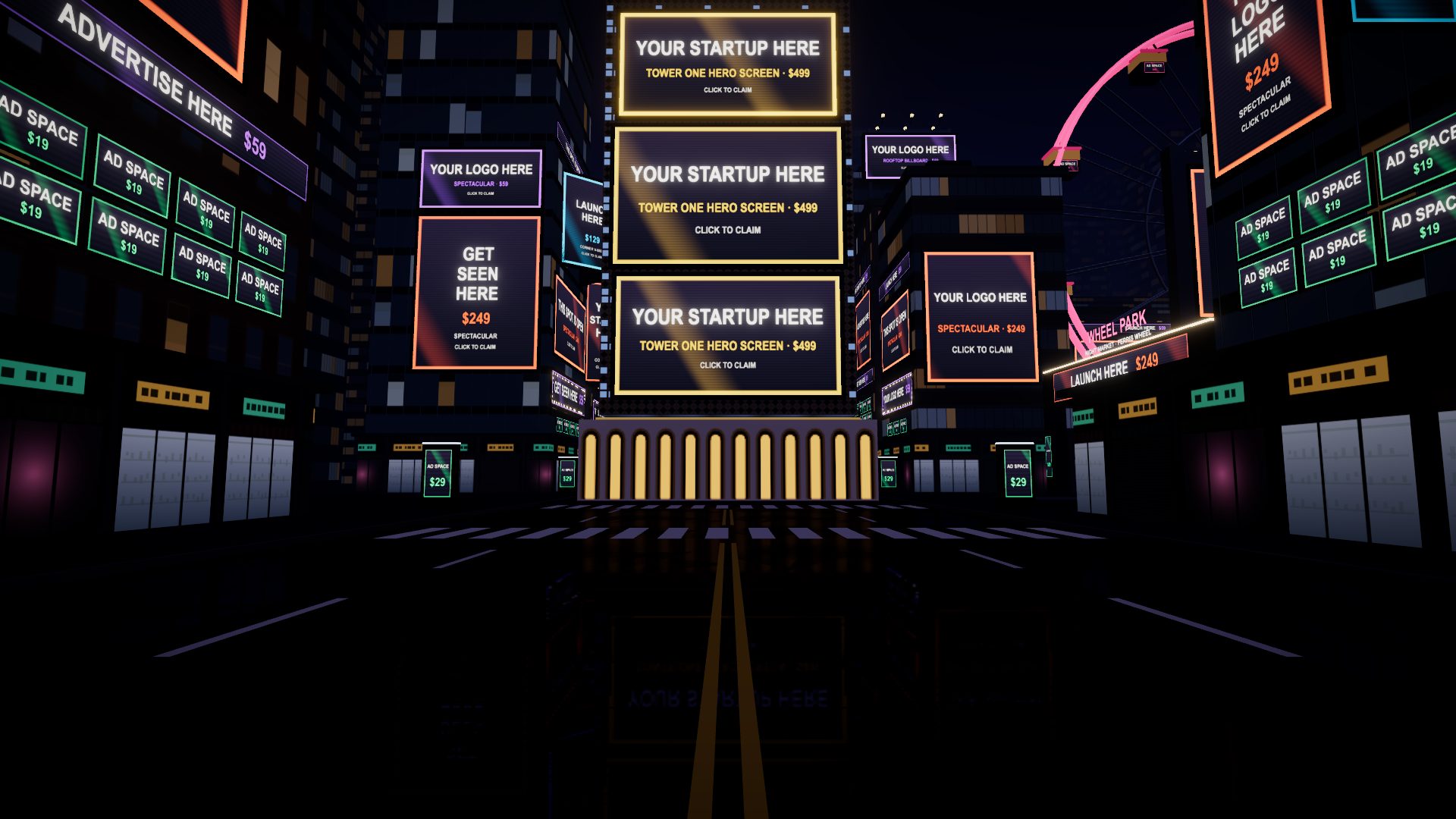
SaaSquare is our take on this idea. It is a walkable 3D version of Times Square that runs in your browser, on desktop or phone, with no download.
Visitors walk down the avenue, look up at the towers, ride a Ferris wheel and wander through a night market. Along the way they pass 379 billboard screens. Every one of them can carry a real product.
Here is how it differs from a physical 3D billboard:
- Every ad is clickable. Click a screen and a panel opens with the brand name, a short tagline and a link to the website. Interest turns into a visit right away.
- You can see what happened. Each screen owner gets a dashboard showing impressions, reach, clicks and visits to their site. We only count an impression when the screen was actually in view, facing the visitor, close enough to read, for at least a second. No guessing about traffic counts.
- The price fits a launch budget. You can rent a screen for 30 days from $9, or own one for 12 months from $29. Bigger screens cost more, and the main hero tower is at the top.
- One owner per screen. Nobody shares your spot or rotates in over you while your ad is up.
- It is easy to share. Every screen has its own link, so you can send people straight to your billboard. "Our ad is on a billboard in Times Square" is a fun line for a launch post, and people can go and walk past it.
There are a lot of screen types, because placement in a 3D city works like the real thing. Big spectacular screens face the avenue. Vertical blades stick out from walls so you can see them from down the street. There are rooftop signs, storefront screens, sidewalk totems, wheel gondolas and market stalls. The small ones are cheap on purpose, since most founders want to start small.
We should be honest about what it is not. SaaSquare is not the real Times Square, and it won't put your logo in front of New York tourists. It is a place on the web where your product sits on a billboard people can walk up to and click. For a launch, that is often the more useful half.
How to make a 3D billboard ad that people notice
Whether you buy a real screen or a virtual one, the same rules help:
- One idea, very simple. People see a billboard for a second or two. A product name and one clear promise beats a list of features.
- Big, bold text. If you can't read it from across a street, it's too small. The same goes for a screen across a virtual street.
- High contrast. Bright on dark stands out on a night scene. Pale gray on white disappears.
- Show the product or the result. A screenshot, a face, a number. Something concrete.
- Make the next step obvious. On a physical billboard, that's a URL or QR code. On a clickable virtual one, it's your tagline and the link behind it.
- Film it and share it. The billboard is half the value. The clip of your billboard is the other half.
Where 3D billboard advertising is heading
A few things look likely over the next few years:
- More screens built for 3D. New screens in big cities are increasingly designed as corners and curves, because that's what makes the illusion work.
- More CGI, with more labeling. Fake out of home won't go away, but audiences are getting better at spotting it, and brands that label their CGI keep more trust.
- More digital places with real ads. Games, browser worlds and 3D cities give brands a spot in a place, not just a slot on a page. They also make ads measurable and clickable.
- Cheaper access. The big change for small brands is price. What used to cost a campaign budget can now cost less than a lunch.
The thread through all of this is the same one the Shinjuku cat started: people share places and moments, not banners.
FAQ
Are 3D billboards real?
Some are, some aren't. Anamorphic billboards like the Shinjuku cat are real videos on real screens, and the 3D effect is an illusion that works from one viewpoint. Fake out of home ads are CGI videos that were never on any street. Virtual billboards are real ad screens inside a digital 3D space.
How do 3D billboards work without glasses?
They use anamorphic perspective. The video is drawn distorted on purpose, usually across a corner screen, so that from one spot on the street the distortion cancels out and objects look like they come out of the screen.
How much does a 3D billboard cost?
A physical one usually means paying for both the creative and the screen. Published estimates put an anamorphic video at roughly $8,000 to $60,000, plus screen rental that can run from about $150 a day for a shared slot to over $100,000 a month in prime spots. A virtual billboard in SaaSquare starts at $9 for 30 days.
Is 3D billboard advertising worth it for a small business?
A physical one rarely is, because of the cost. The ideas behind it are worth borrowing, though: make your ad part of a place, make it easy to share, and make it easy to click. A virtual 3D billboard gives a small brand those three things on a launch budget.
What is the difference between a 3D billboard and a virtual billboard?
A 3D billboard is usually a physical screen showing a 3D-looking video. A virtual billboard is an ad screen inside a digital world. With a virtual billboard, visitors can often click it and go straight to your site.
Want to see it for yourself? Walk the city and look up. If you find a screen you like, here's how buying one works, and here are the prices.